

Simulation-to-Deployment pipeline for Autonomous UAV Intelligence
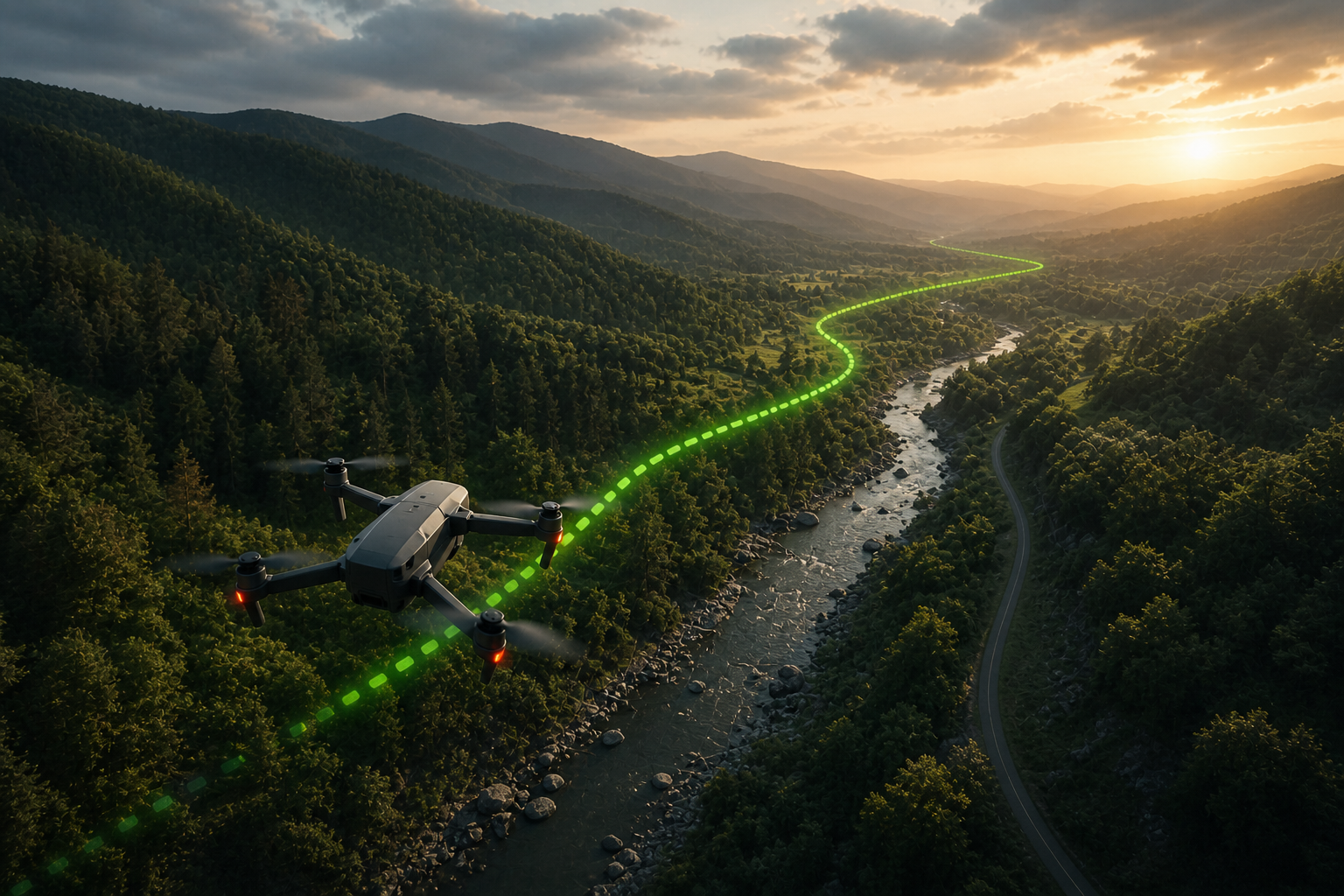
UAV Intelligence Studio is an end-to-end platform for developing,validating, and deploying intelligent UAV systems. A complete solutionthat enables organizations to design, simulate, train, test, and deployintelligent UAV systems without reliance on expensive or risky real-worldtrials. By combining simulation environments, synthetic data generation,and AI model training with edge deployment workflows, the platformreduces development time, improves safety, and enhances performance inreal-world operations.Built for UAV intelligence teams who need repeatable results andauditable validation before flight hours become the bottleneck.It targets sim-to-real gaps: domain gap, sensor-fidelity mismatch, limitedscenario coverage, weak safety cases, missing SITL/HITL progression,poor reproducibility, and labeling bottlenecks. The platform is designed tobridge the simulation-to-real gap through structured validationworkflows, continuous real-world calibration, and safety-driven autonomydevelopment.Built on NVIDIA Omniverse, Isaac Sim, and Isaac Lab, it enables high-fidelity simulation, scalable synthetic data generation, AI training, andseamless edge deployment.It integrates natively with ROS 2, MAVSDK, and autopilot ecosystemssuch as PX4 and ArduPilot, ensuring compatibility from simulation toflight hardware.
Platform Capabilities
- End-to-end simulation-to-flight pipeline for UAV autonomy
- Photorealistic digital twin environments with physics-accuratedynamics
- Safety-driven development with formal validation gates andacceptance criteria
- Continuous sim-to-real bridging through calibration, randomization,and real data integration
- Native integration with ROS2, MAVSDK, and autopilot ecosystems
- Scalable AI training and evaluation with reproducible workflows
- Production-ready edge deployment with monitoring and lifecyclemanagement
Simulator
- High-fidelity, physics-accurate UAV simulation environments built on Omniverse for photorealistic rendering.
- Supports multirotor, VTOL, and fixed-wing configurations with modular UAV models, sensor stacks, and flight controllers. Enables creation of complex operational environments including urban airspace, GPS-denied zones, and dynamic obstacle fields.
- Provides seamless integration with autopilot SITL/HITL workflows and ROS2-based autonomy stacks. Ensures deterministic resets, repeatable scenarios, and regression-grade simulation for continuous validation.
- Designed to support early-stage interface validation, offboard control stability, and safety envelope definition—before any AI training begins.
Synthetic Datasets
- Scalable synthetic data generation powered by Omniverse and RTX-based sensor simulation.
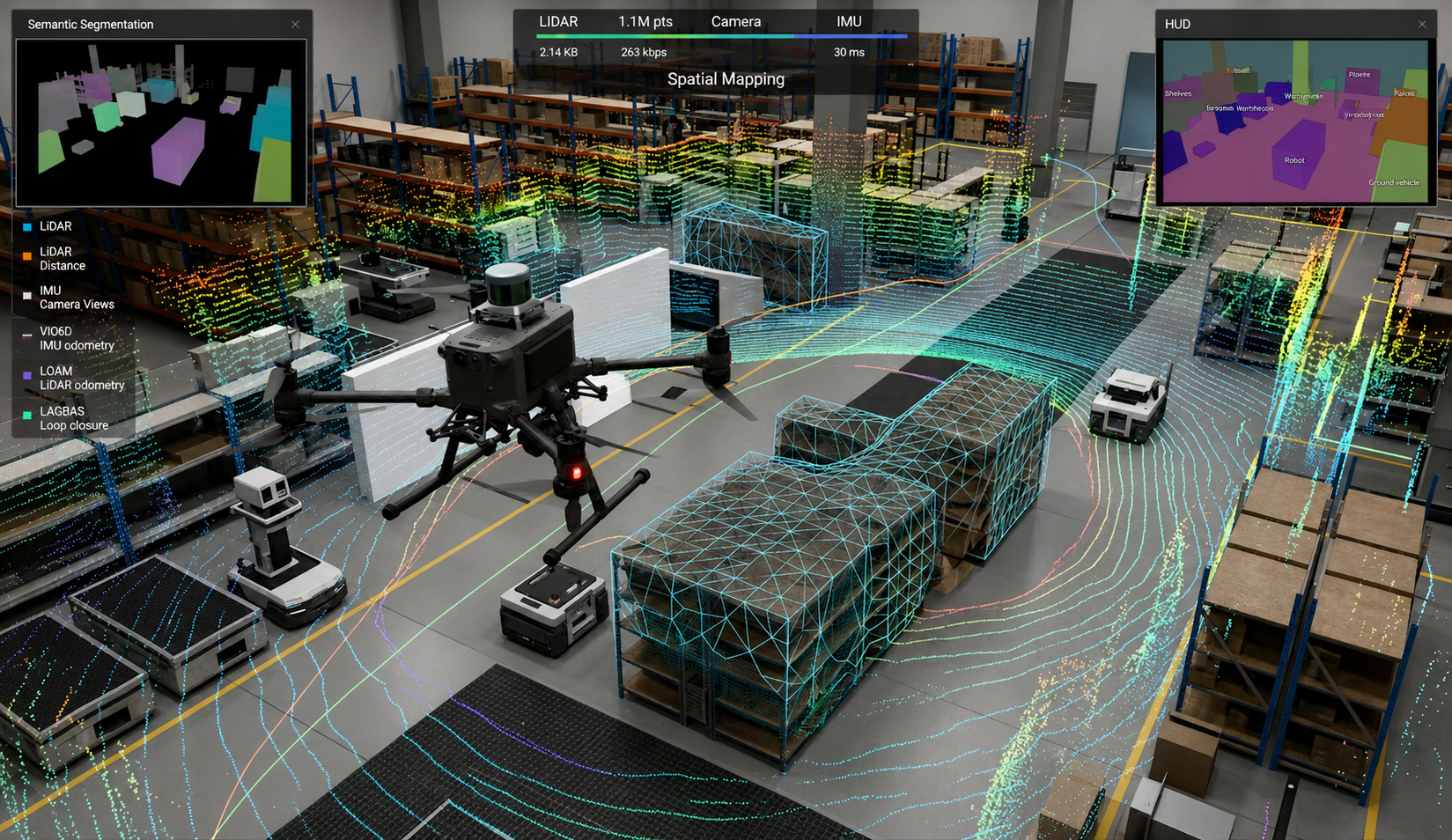
- Generates photorealistic, sensor-consistent datasets with ground truth for detection, tracking, segmentation, depth, and pose estimation. Supports multi-modal sensor simulation including camera, LiDAR, and radar.
- Implements domain and dynamics randomization to improve generalization across real-world conditions. Enables continuous real-to-sim calibration using real flight logs to align sensor noise, latency, and environmental parameters.
- Embeds safety-case-driven dataset design with structured coverage of edge cases, failure modes, and “never-event” scenarios. Ensures datasets are aligned with mission requirements and validation criteria.
Training & Optimization Pipelines
- Closed-loop AI training pipelines for perception, planning, and control within a unified simulation framework.
- Supports hierarchical autonomy architectures combining vision models, skill policies, and high-level planners. Enables large-scale training using simulation rollouts, reinforcement learning, imitation learning, and hybrid approaches.
- Ensures experiment reproducibility through dataset versioning, pipeline orchestration, and continuous integration workflows. Optimized for robustness, reliability, and mission-specific performance metrics.
Edge Computer Deployment Pipelines
- Production-grade deployment pipelines for UAV autonomy on edge compute platforms.
- Optimized for NVIDIA Jetson-based systems with support for ONNX and TensorRT acceleration. Enables real-time inference under strict power, latency, and bandwidth constraints defined early in the development cycle.
- Provides seamless integration with ROS2 and MAVLink-based communication stacks for offboard control. Ensures deterministic command execution, health monitoring, and synchronization with flight controllers.